


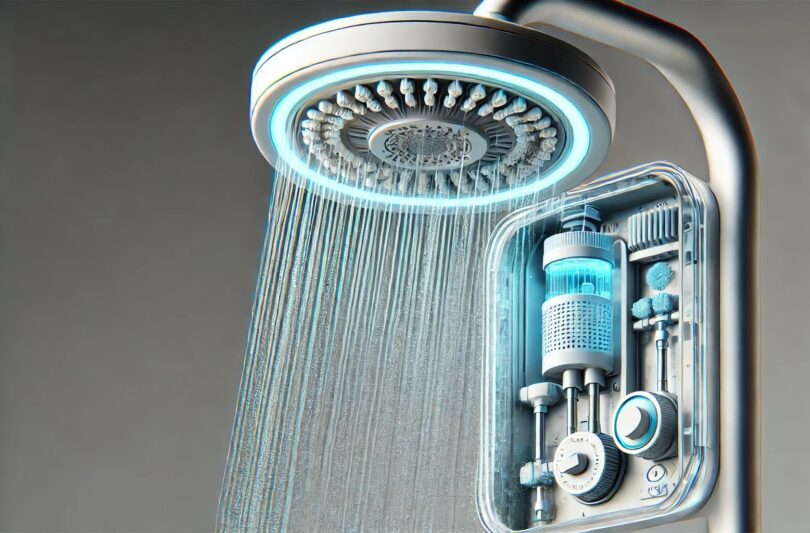

H2O Global News spoke with Lidor Zabari, CEO & Founder of Safe Shower, about tackling the long-standing challenge of Legionella contamination in public and healthcare water systems. His patented, point-of-use disinfection technology aims to reduce risk where it matters most — at the showerhead.
Q&A with Lidor Zabari, CEO & Founder, Safe Shower

Lidor Zabari, CEO & Founder, Safe Shower
1. Legionella remains one of the most persistent challenges in water safety. What makes this bacterium particularly resistant to conventional disinfection methods, and why is it so difficult to eliminate from hospital and public building systems?
Legionella is a unique and highly resilient bacterium found in most surface water sources. It is parasitic, living inside protozoa or amoebae, which makes it extremely difficult to destroy using conventional disinfectants such as chlorine or other chemicals. Filtration offers limited success because Legionella cells are extremely small – around 0.2 microns – which causes filters to clog quickly.
Some authorities rely on thermal treatment, raising hot water temperatures to around 60 °C, but this method is also imperfect. In warm climates, Legionella can even appear in cold water systems, and excessive heating often leads to limescale and sediment build-up. While these measures reduce risk, they do not eliminate it. The greatest vulnerability lies in the final metre of pipework – the faucet or showerhead – where stagnant water allows Legionella to multiply rapidly once it leaves its host organism.
2. Safe Shower was developed to tackle this issue directly at the point of use. Can you explain the concept behind the technology and how it differs from existing Legionella control measures?
The Safe Shower solution is based on a simple yet effective concept: continuous disinfection of stagnant water at the tip of the shower, where risk is greatest. The system prevents air from entering when water flow stops, using unique duckbill valves that create an internal swirl, allowing a small disinfection unit to operate continuously on the residual water. This maintains control at the most critical point in the system, rather than relying solely on centralised measures.
3. Your pilot at Barzilai Hospital has shown promising results. What were the key findings from this first deployment, and how do they demonstrate potential for wider implementation?
The pilot was carried out in a surgical ward with a history of Legionella-positive samples. The results were very encouraging, showing a clear reduction in contamination at the point of use. Because the underlying risk factor – stagnant water at the showerhead – is universal across facilities, the same principle can be applied in any hospital or public building with similar plumbing systems.
4. Energy and water conservation are also growing concerns in building management. How does your approach help reduce waste or improve sustainability in comparison to traditional Legionella control strategies?
Traditional Legionella control often involves flushing water to remove stagnation, which wastes both water and the energy used to heat it. By continuously disinfecting rather than flushing, Safe Shower reduces this waste, conserving resources while maintaining hygienic conditions.
5. Looking ahead, how do you see the future of water safety evolving in healthcare and hospitality — and what role can innovation play in reducing the global burden of Legionnaires’ disease?
Innovation will be central to improving water safety in high-risk environments. I believe that solutions like Safe Shower can play a key role in preventing Legionella growth at the point of use, helping to reduce the incidence of Legionnaires’ disease and save lives worldwide.


